
What Is Stomach Cancer
Stomach cancer begins when abnormal cells in the stomach lining grow uncontrollably. Most cases are adenocarcinomas, which start in the glandular cells of the stomach lining.
Other less common types include:
- Gastrointestinal stromal tumours (GIST)
- Lymphomas
- Carcinoid tumours
Global Statistics
- Incidence & Mortality: In 2020, there were approximately 1 million new cases and 769,000 deaths from stomach cancer globally, making it the fifth most common cancer and the third leading cause of cancer-related deaths.
- Trends: While mortality rates have declined in many countries due to improved detection and treatment, rates remain high in regions like Japan, China, and Eastern Europe.
Who Is at Risk?
- Helicobacter pylori (H. pylori) infection: A common bacterial infection linked to chronic inflammation and ulcers.
- Age: Most cases occur in people over 50.
- Gender: More common in men.
- Diet: High salt, smoked, or pickled food intake increases risk.
- Smoking and alcohol use.
- Family history of stomach cancer.
- Previous stomach surgery or chronic gastritis.
- Certain genetic conditions: Like Lynch syndrome or hereditary diffuse gastric cancer (HDGC).
Common Symptoms
Early-stage stomach cancer often doesn’t cause symptoms, which is why it can go undiagnosed until it's advanced. As the disease progresses, symptoms may include:
- Persistent indigestion or heartburn
- Loss of appetite
- Bloating after meals
- Unexplained weight loss
- Nausea or vomiting
- Stomach pain
- Feeling full quickly
- Vomiting blood or blood in stool
- Fatigue or weakness
If you have persistent or worsening digestive issues, especially with other symptoms, talk to a doctor.
How Is Stomach Cancer Diagnosed?
Endoscopy (Gastroscopy): A thin, flexible tube with a camera is inserted through the mouth to view the stomach and take biopsies.
- Imaging Tests:
- CT scan, MRI, or PET scan to check the spread of cancer.
- Upper GI series (Barium swallow) for examining the stomach lining.
Biopsy: A sample of stomach tissue taken during endoscopy is examined for cancer cells.
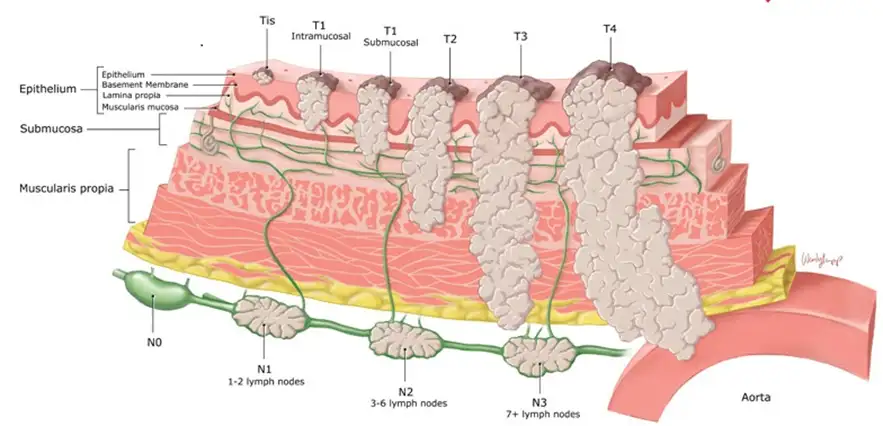
Staging Tests: To determine how far the cancer has spread (stage-1 to stage-4), helping to guide treatment options.
Stages of Stomach Cancer
- Stage 0 (Carcinoma in situ): Abnormal cells in the innermost layer.
- Stage I-II: Cancer has begun to spread into deeper layers of the stomach wall.
- Stage III: Cancer has spread to nearby lymph nodes and tissues.
- Stage IV: Cancer has spread to distant organs (metastatic).
Treatment Options
Treatment depends on the cancer type, stage, and patient’s health:
Surgery
Subtotal (partial) gastrectomy: Removal of part of the stomach.
Total gastrectomy: Removal of the entire stomach.
Lymph node dissection: Removal of nearby lymph nodes to prevent spread.
Chemotherapy
- Used before surgery (neoadjuvant) to shrink tumours, or after surgery (adjuvant) to kill remaining cells.
- In advanced cancer, it may be used to control symptoms and slow progression.
Radiation Therapy
Often combined with chemotherapy to target and kill cancer cells.
Can preserve voice and appearance in some cases
Targeted Therapy
- Drugs that attack specific cancer cell features, such as HER2-positive stomach cancer.
- Example: Trastuzumab (Herceptin)
- Drugs that attack specific cancer cell features, such as HER2-positive stomach cancer.
Immunotherapy
Boosts the body’s natural defences to fight cancer (e.g., pembrolizumab)
Living With Stomach Cancer
- Nutritional support: Smaller, more frequent meals; dietitian guidance.
- Emotional support: Support groups, counselling.
- Regular follow-ups: To monitor recurrence and manage side effects.
Prevention and Early Detection
- Treat H. pylori infection early.
- Healthy diet: Low in salt/pickled foods; rich in fruits and vegetables.
- Avoid smoking and excessive alcohol.
- Screening: In high-risk countries (like Japan and South Korea).
Advances in Diagnostics
Artificial Intelligence (AI) in Diagnosis: Harvard’s AI model “Chief” has shown up to 94% accuracy in detecting cancers via tissue image analysis.
Immunotherapy
Dostarlimab: In a groundbreaking study, the immunotherapy drug dostarlimab showed that 92% of patients with mismatch repair-deficient cancers, including stomach cancer, remained cancer-free for at least two years without surgery or chemotherapy. This treatment is particularly effective for cancers with specific genetic mutations.
Cadonilimab (AK104): A bispecific antibody targeting both PD-1 and CTLA-4, cadonilimab has shown promising results in combination with chemotherapy for HER2-negative gastric cancers, offering improved survival rates.
Targeted Therapy
Zolbetuximab (Vyloy): Approved in 2024, zolbetuximab is a monoclonal antibody targeting claudin 18.2, a protein expressed in certain gastric cancers. When combined with chemotherapy, it has demonstrated improved survival in patients with HER2-negative, claudin 18.2-positive advanced gastric cancer.
Cancer Vaccine
Personalized mRNA Vaccine: In a clinical trial, a personalized mRNA vaccine developed by Moderna and MSD was administered to a patient with gastro-oesophageal cancer in Dundee, Scotland. This vaccine aims to stimulate the immune system to target cancer cells more effectively.
FAQs about Stomach Cancer
What not to eat when you have stomach cancer?
You should avoid highly processed and sugary foods, alcohol, acidic foods like citrus, spicy foods, tough foods like raw vegetables and nuts, and caffeinated beverages. It is also recommended to limit salted and pickled foods, and those with tough textures or high fibre content as they can irritate the digestive system and worsen symptoms or complicate treatment.
How does stomach cancer usually start?
Stomach cancer starts when cells in the stomach's inner lining undergo abnormal DNA changes, causing them to grow and multiply uncontrollably to form a tumor. This process is often linked to a chronic infection from the Helicobacter pylori (H. pylori) bacteria or is influenced by risk factors like a diet high in salt, smoked foods, or low in fruits and vegetables, as well as smoking, alcohol, and obesity.
Is stomach cancer hereditary?
No, most stomach cancer is not hereditary; only a small percentage, between 1-3%, is caused by inherited genetic syndromes, such as Hereditary Diffuse Gastric Cancer (HDGC) which involves a mutation in the CDH1 gene.
What infection causes stomach cancer?
Infection with H. pylori is the strongest known risk factor for gastric cancer, which is the second leading cause of cancer-related deaths worldwide.
Where can I find a Specialist for Head and Neck Cancer?
You can search your Head and Neck Cancer Specialist on www.ioncosolutions.com