
What Is Gallbladder Cancer?
Gallbladder cancer is a rare type of cancer that begins in the gallbladder, a small pear-shaped organ located beneath the liver. The gallbladder's main function is to store bile, a substance produced by the liver that helps in digesting fats.
In gallbladder cancer, abnormal cells begin to grow uncontrollably in the gallbladder, leading to the formation of a tumour. The majority of gallbladder cancers are adenocarcinomas, which develop in the cells lining the inside of the gallbladder.
Global Statistics (2022)
- Incidence: Approximately 122,491 new cases of gallbladder cancer were reported worldwide in 2022, making it the 22nd most common cancer globally.
- Mortality: Around 89,055 deaths occurred due to gallbladder cancer in 2022, highlighting its aggressive nature and the challenges in early detection.
- High-Risk Regions: Countries with the highest age-standardized rates (ASR) of gallbladder cancer include Bangladesh, Chile, and India, particularly in regions like Northeastern India and Southern Chile, where ASRs can exceed 6.0 per 100,000 population.
Who Is at Risk?
Several factors can increase the risk of developing gallbladder cancer:
- Age: Gallbladder cancer is more common in people over 60.
- Gender: Women are more likely to develop gallbladder cancer than men.
- Gallstones: Having gallstones is the most common risk factor for gallbladder cancer. Chronic inflammation of the gallbladder due to gallstones can increase cancer risk.
- Chronic infection: Certain chronic infections, such as Porphyromonas gingivalis bacteria or the presence of Salmonella, are associated with increased cancer risk.
- Family history: A family history of gallbladder cancer may increase the risk.
- Obesity: Being overweight or obese increases the risk.
- Other conditions: Diseases like primary sclerosing cholangitis (a liver disease) and biliary tract diseases can raise the likelihood of developing gallbladder cancer.
Common Symptoms
Gallbladder cancer often doesn't cause symptoms in its early stages, making it difficult to detect until it’s more advanced. When symptoms do occur, they may include:
- Pain in the upper right abdomen: This is the most common symptom and may feel like a dull ache.
- Jaundice: Yellowing of the skin or eyes caused by a blockage in the bile ducts.
- Nausea or vomiting: Unexplained nausea or vomiting may occur, especially after eating.
- Unexplained weight loss: A noticeable drop in weight without trying.
- Bloating or indigestion: Feeling full or bloated after eating.
- Fever: This may develop if the cancer leads to infection or obstruction.
How Is Gallbladder Cancer Diagnosed?
The diagnosis of gallbladder cancer may involve several tests, including:
Imaging Tests
- Ultrasound: A first-line test to visualize the gallbladder and any abnormalities, such as tumours or gallstones.
- CT Scan: A detailed imaging technique that can help determine the size and spread of the tumour.
- MRI: Sometimes used to get more detailed images of the gallbladder and bile ducts.
- PET Scan: A nuclear scan that helps detect cancer spread to other parts of the body.
Endoscopic Retrograde Cholangiopancreatography (ERCP):
- A procedure where a flexible tube with a camera is inserted into the digestive tract to examine the bile ducts and gallbladder. It can also allow for biopsy or removal of blockages.
Biopsy:
- A sample of tissue is taken from the gallbladder or surrounding areas and analysed in the laboratory to confirm cancer.
Blood Tests:
- While no blood tests can definitively diagnose gallbladder cancer, certain tests (like liver function tests) can show abnormal levels that suggest bile duct obstruction or liver involvement.
Stages of Gallbladder Cancer
Staging refers to how far cancer has spread and helps determine treatment options. The stages of gallbladder cancer are as follows:
- Stage 0: Cancer is only in the inner lining of the gallbladder.
- Stage I: Cancer has grown into the wall of the gallbladder.
- Stage II: Cancer has spread to nearby tissues but not to lymph nodes.
- Stage III: Cancer has spread to nearby organs (like the liver or bile ducts) or lymph nodes.
- Stage IV: Cancer has spread to distant parts of the body, such as the lungs or bones.
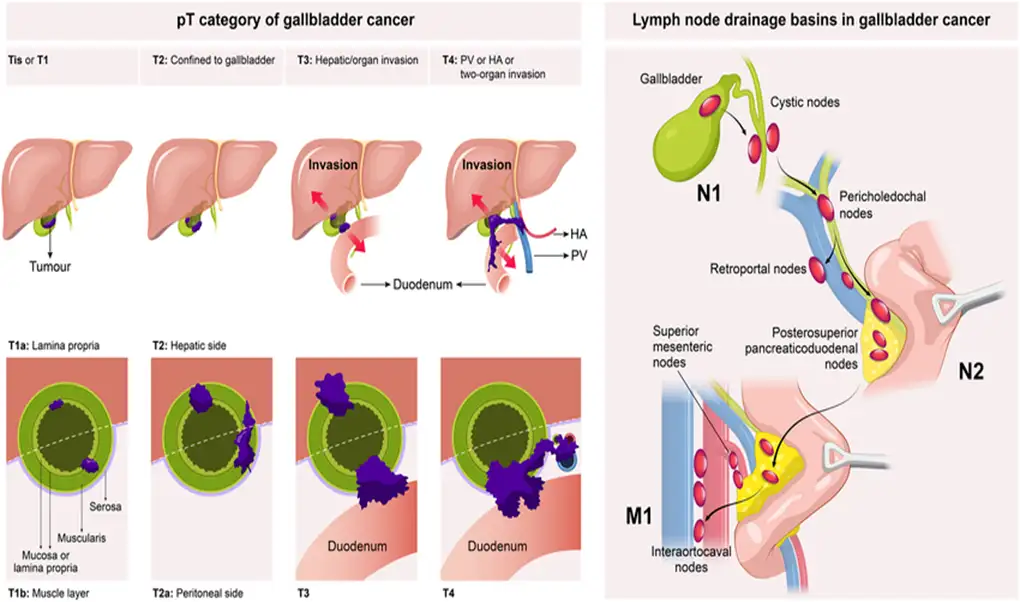
AJCC 8th edition TNM staging system for gallbladder cancer.
Treatment Options
Treatment for gallbladder cancer depends on the cancer's stage, location, and the patient's overall health. Treatment options may include:
Surgery
- Cholecystectomy: Removal of the gallbladder, which may be possible if the cancer is detected early and has not spread.
- Radical Surgery: For more advanced cases, surgeons may remove the gallbladder along with parts of the liver, bile ducts, and lymph nodes.
Chemotherapy:
- Chemotherapy is often used for gallbladder cancer that has spread to other parts of the body. It involves the use of drugs that kill cancer cells. Chemotherapy may be used before or after surgery or as the primary treatment for advanced cancer.
Radiation Therapy:
- Radiation therapy uses high-energy rays to target and kill cancer cells. It may be used after surgery or in cases where surgery is not possible.
Targeted Therapy:
- Targeted therapies aim to target specific molecules that drive cancer growth. For example, gemcitabine and cisplatin are commonly used chemotherapy drugs for gallbladder cancer, and there are ongoing studies into other targeted therapies.
Immunotherapy:
- Immunotherapy drugs, like checkpoint inhibitors , work by helping the body's immune system recognize and attack cancer cells. Though still under investigation, immunotherapy holds promise for advanced gallbladder cancer.
Palliative Care:
- If the cancer is not curable, palliative care focuses on managing symptoms, improving the patient's quality of life, and providing comfort during treatment.
Prevention
While some risk factors for gallbladder cancer, such as age and genetics, cannot be controlled, there are steps that may help reduce the risk:
- Maintain a healthy weight: Losing weight if overweight or obese can lower the risk of gallbladder cancer.
- Treat gallstones: If you have gallstones or are at high risk of them, talk to your doctor about potential treatments to reduce complications.
- Healthy diet: Eating a diet rich in fruits, vegetables, and whole grains while limiting fat and processed foods can help lower the risk.
- Manage underlying conditions: Managing chronic diseases like diabetes and liver disease can reduce the risk of gallbladder cancer.
Living With Gallbladder Cancer
Living with gallbladder cancer can be challenging, but there are strategies to help manage physical and emotional well-being:
- Dietary changes: After surgery or during treatment, some patients may need to eat smaller, more frequent meals or avoid certain foods that aggravate symptoms.
- Emotional support: Coping with cancer can be emotionally difficult, and seeking support from family, friends, or a counselor can be very helpful.
- Symptom management: Medications can help alleviate symptoms like pain, nausea, and fatigue.
- Palliative care: For advanced stages, palliative care can help with symptom control, providing better quality of life.
Advancements in Diagnostics
Molecular Profiling:
Recent studies have identified specific genetic mutations, such as IDH1 mutations and FGFR2 fusions, in gallbladder cancer. These findings pave the way for targeted therapies and personalized treatment approaches.
Imaging Techniques:
Advancements in imaging technologies, including high-resolution MRI and CT scans, have improved the ability to detect gallbladder tumours at earlier stages, facilitating timely intervention.
Emerging Treatments
Targeted Therapies:
New drugs targeting specific genetic alterations in gallbladder cancer cells are under investigation. For instance, therapies targeting FGFR2 and IDH1 mutations have shown promise in early clinical trials.
Immunotherapy:
Immunotherapeutic agents, such as immune checkpoint inhibitors , are being explored for their potential to enhance the body's immune response against gallbladder cancer cells. Preliminary studies indicate potential efficacy, especially in advanced stages.
Chemotherapy:
Traditional chemotherapy remains a cornerstone in the treatment of gallbladder cancer, particularly for advanced or metastatic cases. Agents like gemcitabine and cisplatin are commonly used, often in combination.
FAQs about Gallbladder Cancer
How painful is gallbladder cancer?
You can get an aching feeling on your right side if you have gallbladder cancer. Some people describe it as a dragging feeling. If the cancer or gallstones block the bile duct, you will have a sharper pain.
What to expect when you have gallbladder cancer?
As the disease progresses, signs of gallbladder cancer can include Abdominal pain, Nausea and vomiting. Yellowing of the skin and eyes, called jaundice.
How long do you live with gallbladder cancer?
Gallbladder cancer life expectancy is generally poor, with overall 5-year survival rates around 20-30% but varies significantly by stage. Patients with localized cancer have a much better prognosis (around 66-69%), while those with distant metastatic disease have very poor outcomes (around 2-3%). Factors like early diagnosis and response to treatment greatly influence survival, with surgical removal being the only potential for cure, especially in early-stage cases
What age is gallbladder cancer most common?
Gallbladder cancer is seen mostly in older people, but younger people can develop it as well. The average age of people diagnosed is 72. Most people with gallbladder cancer are 65 or older when it's found.
Is gallbladder cancer hereditary?
Gallbladder cancer is not directly hereditary, but having a family history of the disease, especially a parent or sibling with it, can increase your risk. This increased risk is often due to shared genes or environmental factors within families, rather than a direct inheritance of the cancer itself. Other significant risk factors include gallstones, chronic inflammation, obesity, smoking, and certain ethnicities.
Can you live without your gallbladder?
The short answer is yes. Your gallbladder isn't essential, so you can live normally without it. Some patients will notice that if they eat a heavy, greasy meal after their gallbladder is out their bowels are a little loose.
How to avoid/prevent gallbladder cancer?
Get to and stay at a healthy weight. Keep physically active and limit the time you spend sitting or lying down. Eat plenty of fruits, vegetables, and whole grains, and limit or avoid red and processed meats, sugary drinks, and highly processed foods. It's best not to drink alcohol.
What is the best treatment for gallbladder cancer?
Whenever possible, surgery is the main treatment. It's the best chance of curing the cancer. Because of this, doctors generally classify gallbladder cancers as: Resectable, those that doctors believe can be removed completely by surgery, based on the results of imaging procedures and other tests.
Where can I find a Specialist for Gallbladder Cancer?
You can search your Gallbladder Cancer Specialist on www.ioncosolutions.com